Shopping for an espresso machine for beginners usually comes down to one tradeoff: how much learning curve are you willing to accept in exchange for better coffee? Machines range from steam-driven models that make something espresso-adjacent with zero skill, to pump-driven machines that reward practice with genuine café-quality shots. In this comparison, the Breville Bambino stands out as the best overall pick for beginners, thanks to its fast heat-up, low-pressure pre-infusion, and automatic milk texturing that hides most of the learning curve. If budget leads your decision, the De’Longhi Stilosa delivers real 15-bar pump espresso at a fraction of the price, while the CASABREWS 3700 offers the best balance of stainless build and steam wand control among the mid-range compact options. The biggest divide in this lineup is between 3.5-bar steam machines and 20-bar pump machines — a difference that matters more than any feature list suggests. Keep reading for the full breakdown of all 15 machines and which one fits your kitchen, budget, and patience level.

Get your wardrobe favorites delivered free with Prime
- Fast, free delivery on millions of items
- Prime Video, Amazon Music and more included
- Member-only deals all year
Complete the kit


Key Takeaways
- Only one machine in this lineup — the Breville Bambino — offers automatic milk texturing, which removes the single hardest skill beginners need to learn; every other option requires manual steam wand practice.
- The 3.5-bar steam-driven models (XIXUBX Compact and similar) cannot produce true espresso regardless of technique, because real espresso requires at least 9 bars of pump pressure — they’re better understood as strong coffee makers.
- A built-in pressure gauge, found on the CHULUX Slim, is the most underrated beginner feature in this roundup because it gives instant feedback on whether your grind and tamp are correct.
- Four of the fifteen machines are near-identical XIXUBX variants differing mainly in color and wattage, so choosing between them comes down to aesthetics and price rather than performance.
- The De’Longhi Stilosa proves that a genuine 15-bar pump machine with a metal boiler and real steam wand can sit at the entry-level price point, making most feature-heavy 20-bar competitors harder to justify.
| CHULUX Slim Espresso Machine with Milk Frother and Pressure Gauge |  | Best Overall for Beginners | Pump Pressure: 20 bar | Power: 1350 watts | Preheating Time: 30 seconds | VIEW ON AMAZON | See Our Full Breakdown |
| CASABREWS 3700 Essential Stainless Steel Espresso Machine with Steam Wand |  | Best Value Semi-Automatic | Pressure: 20 bar | Power: 1350 watts | Operation Mode: Semi-automatic | VIEW ON AMAZON | See Our Full Breakdown |
| XIXUBX Compact Espresso & Cappuccino Machine, 3.5 Bar with Steam Wand |  | Best Ultra-Budget Starter | Pressure: 3.5 bar | Power: 800W | Dimensions: 8.3″D x 6″W x 11.8″H | VIEW ON AMAZON | See Our Full Breakdown |
| XIXUBX Espresso Machine with Milk Frother, Grey |  | Best for Iced Coffee Drinkers | Type: Semi-automatic espresso machine | Pump Pressure: 20 bar | Power: 1350W | VIEW ON AMAZON | See Our Full Breakdown |
| AMZCHEF 20 Bar Compact Espresso Machine, Matte Silver |  | Best Touchscreen Pick for Small Kitchens | Pump Pressure: 20 bar | Power: 1350W | Warm-Up Time: 30-40 seconds | VIEW ON AMAZON | See Our Full Breakdown |
| Aromaster 1400W Espresso Machine with Milk Frother, Stainless Steel |  | Best for Iced Coffee Drinkers | Power: 1400W | Pressure: 20 bar | Water Tank Capacity: 37 oz (removable) | VIEW ON AMAZON | See Our Full Breakdown |
| CASABREWS CM5418 Compact Espresso Machine with Milk Frothing Wand |  | Best Budget Learning Tool | Type: Semi-automatic espresso machine | Pump Pressure: 20 bar | Wattage: 1350W | VIEW ON AMAZON | See Our Full Breakdown |
| Breville Bambino Espresso Machine, Brushed Stainless Steel | 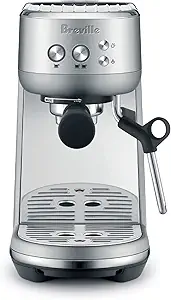 | Best Premium Beginner Pick | Model: BES450BSS | Heating System: ThermoJet | Heat-Up Time: 3 seconds | VIEW ON AMAZON | See Our Full Breakdown |
| SHARDOR 20 Bar Espresso Machine with Milk Frother and Touchscreen, Stainless Steel |  | Best for Frequent Drinkers | Pressure: 20 bar | Wattage: 1350W, 120V | Water Tank Capacity: 45 oz (removable) | VIEW ON AMAZON | See Our Full Breakdown |
| Gevi 20-Bar Compact Espresso Machine for Home | 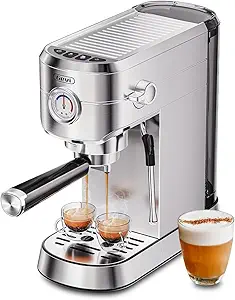 | Best Balance of Price and Control | Pressure: 20 bar | Temperature Control: NTC | Type: Semi-automatic espresso machine | VIEW ON AMAZON | See Our Full Breakdown |
| ATATIX Espresso Machine with Milk Frother, 20 Bar Pressure Espresso Maker |  | Best for Learning Shot Control | Pressure: 20 bar | Temperature Control: NTC precision, 90–96°C | Preheat Time: 30 seconds | VIEW ON AMAZON | See Our Full Breakdown |
| De’Longhi Stilosa Compact Manual Espresso Machine with Milk Frother | 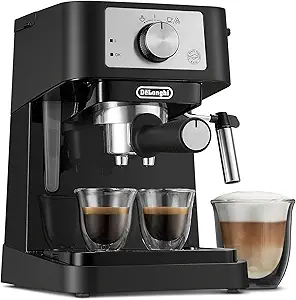 | Best Trusted Brand on a Budget | Type: Manual espresso machine | Boiler: Stainless steel | Milk Frother: Manual steam wand | VIEW ON AMAZON | See Our Full Breakdown |
| XIXUBX Compact Espresso Machine with Milk Frother, White |  | Best for Tiny Kitchens | Pressure: 20 bar | Temperature Control: PID | Brew Time: 22–30 seconds | VIEW ON AMAZON | See Our Full Breakdown |
| Espresso Machine 20 Bar with Milk Frother, Stainless Steel Compact Cappuccino Maker (Silver) |  | Best for Visual Learners | Pressure: 20 bar with visible gauge | Type: Semi-automatic | Power: 1450W | VIEW ON AMAZON | See Our Full Breakdown |
| XIXUBX Espresso Machine with Milk Frother for Cappuccino & Latte, Silver |  | Best for Entertaining and Volume | Pressure: 20 bar with visible gauge | Steam Wand: 360° rotating, detachable | Water Tank: 42 oz, removable | VIEW ON AMAZON | See Our Full Breakdown |
| espresso machine for beginner | Pressure | Power |
|---|---|---|
| CHULUX Slim Espresso Machine w | — | 1350 watts |
| CASABREWS 3700 Essential Stain | 20 bar | 1350 watts |
| XIXUBX Compact Espresso & Capp | 3.5 bar | 800W |
| XIXUBX Espresso Machine with M | — | 1350W |
| AMZCHEF 20 Bar Compact Espress | — | 1350W |
| Aromaster 1400W Espresso Machi | 20 bar | 1400W |
| CASABREWS CM5418 Compact Espre | — | — |
| Breville Bambino Espresso Mach | — | 1560W, 110–120V |
| SHARDOR 20 Bar Espresso Machin | 20 bar | — |
| Gevi 20-Bar Compact Espresso M | 20 bar | — |
| ATATIX Espresso Machine with M | 20 bar | — |
| De’Longhi Stilosa Compact Manu | — | — |
| XIXUBX Compact Espresso Machin | 20 bar | — |
| Espresso Machine 20 Bar with M | 20 bar with visible gauge | 1450W |
| XIXUBX Espresso Machine with M | 20 bar with visible gauge | — |
More Details on Our Top Picks
CHULUX Slim Espresso Machine with Milk Frother and Pressure Gauge
This pick earns the top spot because it solves the two biggest beginner problems: knowing whether you’re brewing correctly and fitting a machine into a small kitchen. The built-in pressure gauge gives instant visual feedback, which the CASABREWS 3700 lacks — you can see when your grind and tamp are off instead of guessing why a shot tastes sour. Pre-infusion smooths out extraction errors, another safety net for new baristas. Compared with the AMZCHEF 20 Bar, the CHULUX trades the touch screen for a 5.5-inch slim footprint, making it the better choice for cramped counters. The 30-second heat-up means no waiting around before a morning shot. The tradeoff: there’s little room to grow, so intermediate users who want programmability will outgrow it within a year.
Pros:- Pressure gauge gives beginners visible feedback on extraction quality
- Pre-infusion reduces the impact of grind and tamp mistakes
- Slim 5.5-inch width fits tight counters and offices
- Fast 30-second preheating for quick morning shots
Cons:- Few advanced controls, so growing baristas will hit a skill ceiling
- Basic build quality compared with semi-automatic machines at higher tiers
Best for: First-time espresso buyers who want visual feedback (pressure gauge) to learn dialing in shots without wasting beans
Not ideal for: Hobbyists planning to upgrade skills with programmable settings or PID control — the fixed workflow caps how far you can develop
- Pump Pressure:20 bar
- Power:1350 watts
- Preheating Time:30 seconds
- Water Tank Capacity:40 oz removable
- Width:5.5 inches
- Auto Shut-Off:After 25 minutes of inactivity
- Key Features:Steam wand, pressure gauge, pre-infusion, removable drip tray
Our verdict“The most forgiving entry point in this lineup, ideal for anyone who wants to learn espresso fundamentals with a gauge as their coach.”
CASABREWS 3700 Essential Stainless Steel Espresso Machine with Steam Wand
Where the CHULUX Slim teaches you to read a gauge, the CASABREWS 3700 teaches you the classic semi-automatic workflow: grind, tamp, pull, steam. That traditional skill-building path makes this the strongest value pick — it includes both single- and double-shot filters plus a tamper, so the box is genuinely complete, unlike the XIXUBX Grey model which leans on push-button convenience instead. The stainless steel body also feels more durable than the plastic-clad competition. Its steam wand produces real microfoam suitable for latte art, which puts it ahead of entry machines that only make bubbly froth. The honest downside: there’s no pressure gauge or temperature display, so diagnosing a bad shot relies purely on taste and practice, and the wand demands cleaning after every session.
Pros:- Complete kit with one- and two-cup filters, portafilter, and tamper included
- Stainless steel construction feels more durable than plastic rivals
- 43.9 oz removable tank handles several drinks between refills
- Steam wand produces microfoam fine enough for latte art
Cons:- No pressure gauge or temperature readout to help diagnose bad shots
- Steam wand needs cleaning after each use or performance degrades
Best for: Budget-conscious beginners who want to build genuine barista technique on a manual semi-automatic machine
Not ideal for: Buyers wanting a zero-effort start — it requires a first-use setup cycle and hands-on wand maintenance after every drink
- Pressure:20 bar
- Power:1350 watts
- Operation Mode:Semi-automatic
- Water Tank Capacity:43.9 oz removable
- Body Material:Stainless steel
- Coffee Input:Ground coffee
- Included:Portafilter, one- and two-cup filters, tamper with spoon
Our verdict“The best low-cost path to real espresso skills, as long as you accept that learning here means trial and error rather than readouts.”
XIXUBX Compact Espresso & Cappuccino Machine, 3.5 Bar with Steam Wand
This is the honest floor of the category, and it belongs here for one reason: almost nothing is cheaper or simpler to operate. The single mechanical knob — brew, steam, off — makes it approachable for seniors, students, and RV travelers in a way no touchscreen model like the AMZCHEF can match, and at 3.3 lbs it moves between dorm, office, and camper without fuss. But buyers need to understand the physics: 3.5 bar is well below the 9-bar espresso standard, so drinks come out closer to strong moka-pot coffee than true espresso, with thinner crema than the 20-bar machines in this roundup. The CASABREWS 3700 costs more but delivers authentic pressure. Treat this as a coffee-and-froth convenience machine, not a barista training tool, and the tradeoff makes sense.
Pros:- One-knob operation with no fragile electronics, genuinely beginner-proof
- Ultra-light 3.3 lb body travels easily to dorms, offices, and RVs
- Cool-touch steam wand grip and safety lock prevent scalding accidents
- BPA-free Tritan cup with measurement markings included
Cons:- 3.5-bar pressure produces milder, less intense coffee than 9+ bar machines
- No advanced controls or programmable settings of any kind
Best for: Dorm residents, RV owners, and casual coffee drinkers who want milky coffee drinks with minimal cost and zero learning curve
Not ideal for: Anyone chasing authentic espresso with thick crema — the 3.5-bar pressure simply cannot produce true espresso extraction
- Pressure:3.5 bar
- Power:800W
- Dimensions:8.3″D x 6″W x 11.8″H
- Weight:3.3 lbs
- Controls:Single mechanical knob (Brew/Steam/Off)
- Cup Material:BPA-free Tritan
- Warranty:1 year
Our verdict“A fair deal only if you value simplicity and portability over authentic espresso quality.”
XIXUBX Espresso Machine with Milk Frother, Grey
This model earns its slot for a feature almost no budget rival offers: one-touch cold brew. If your household drinks iced lattes year-round, the CHULUX and CASABREWS 3700 can’t make a cold extraction at all — you’d be pulling hot shots over ice and hoping for the best. Here, a dedicated button handles it. The NTC temperature sensor keeps hot shots consistent, and the included rust-resistant milk pitcher means one less accessory to buy. The compromise is control: unlike the CHULUX’s gauge or the CASABREWS’ manual workflow, this machine has no pressure gauge, no temperature dial, no adjustable extraction parameters. It’s built around convenience, not craft. Buyers who want to tinker should look elsewhere; buyers who want push-button variety will feel right at home.
Pros:- Unique one-touch cold brew mode unavailable on most budget rivals
- 30-second heat-up supports fast back-to-back drinks
- Steam wand and included milk pitcher cover hot milk drinks out of the box
- Push-button controls require essentially no learning curve
Cons:- No pressure gauge or temperature dial for manual adjustment
- Less room to develop barista skills than manual semi-automatics
Best for: Iced-latte and cold brew fans who want one machine covering both hot espresso and cold drinks with minimal fuss
Not ideal for: Tinkerers and aspiring home baristas — there are no gauges or dials for adjusting or learning the extraction process
- Type:Semi-automatic espresso machine
- Pump Pressure:20 bar
- Power:1350W
- Heat-Up Time:About 30 seconds
- Brewing Options:Hot espresso and one-touch cold brew
- Temperature Control:NTC sensor
- Milk Frother:Adjustable steam wand
- Included Accessory:Rust-resistant milk pitcher
- Warranty:1 year
Our verdict“The easiest way to cover both hot and cold coffee habits in one compact machine, provided you don’t need to fine-tune anything.”
AMZCHEF 20 Bar Compact Espresso Machine, Matte Silver
The AMZCHEF sits between the CASABREWS 3700’s fully manual approach and a true one-touch machine. Its LED touch screen handles single and double shots with a tap, which removes one common beginner mistake — cutting the shot too long or short — while still using a real portafilter so you keep control over grind and tamp. The full accessory kit (portafilter, filter baskets, tamper) matches what CASABREWS includes, so nothing extra is needed on day one. Compared with the XIXUBX 3.5-bar model, the 20-bar pump and stable temperature deliver genuinely thick crema for barely more counter space. Two honest caveats: the steam wand takes practice before it produces latte-art-grade foam, and the touch panel’s custom settings aren’t immediately intuitive for less tech-comfortable users.
Pros:- One-touch LED screen removes shot-timing guesswork for beginners
- 20-bar Italian pump produces thick golden crema with minimal technique
- Complete accessory kit means everything needed ships in the box
- Compact brushed stainless steel body suits small countertops
Cons:- Steam wand requires practice before achieving advanced latte-art microfoam
- Touch panel custom settings carry a learning curve for some users
Best for: Tech-comfortable beginners in small kitchens who want push-button shot consistency with room to practice milk frothing
Not ideal for: Less tech-savvy buyers or those wanting analog simplicity — the touch panel adds a learning curve a dial-based machine avoids
- Pump Pressure:20 bar
- Power:1350W
- Warm-Up Time:30-40 seconds
- Water Tank Capacity:1.2L (41 oz) detachable
- Controls:LED touch screen, single/double shot
- Steam Wand:Adjustable 8mm one-piece
- Body Material:Brushed stainless steel
- Included:Portafilter, filter baskets, tamper
Our verdict“A balanced middle ground for beginners who prefer a screen over switches but still want a real portafilter to grow into.”
Aromaster 1400W Espresso Machine with Milk Frother, Stainless Steel
Most beginner machines force you to choose between hot and cold drinks, but the Aromaster’s dual-circuit system lets you switch between hot espresso and iced coffee without waiting, which is a genuine rarity at this level. Compared with the CASABREWS CM5418, which needs a cool-down period after steaming, the Aromaster keeps the workflow moving — a real advantage if your household splits between latte drinkers and iced-coffee fans. The PID + NTC temperature control does the forgiving work for you, holding brew temperature steady even when your grind is slightly off, and one-touch descaling takes the scariest maintenance task off your plate. The tradeoff: the 2.4 oz brew capacity is the smallest in this batch, so back-to-back drinks take longer, and the touch screen adds a layer of menus to learn.
Pros:- Dual-circuit system switches instantly between hot and iced coffee
- PID + NTC temperature control keeps extraction consistent even with imperfect technique
- One-touch descaling makes the most intimidating maintenance step simple
- Compact 7-inch-wide footprint fits tight counters
Cons:- 2.4 oz brew capacity limits larger or multiple drinks
- Touch screen menus add a learning curve compared with simple dial controls
Best for: Households where some drinkers want hot espresso drinks and others want iced coffee from one machine
Not ideal for: Anyone who regularly makes multiple large drinks in a row — the 2.4 oz capacity means lots of refills
- Power:1400W
- Pressure:20 bar
- Water Tank Capacity:37 oz (removable)
- Controls:Touch screen
- Material:Stainless steel
- Dimensions:13″D x 7″W x 14″H
- Special Features:Pre-infusion, PID temperature control, cup warmer, auto shut-off, one-touch descaling
Our verdict“This pick makes the most sense for beginners who want one machine that handles both hot lattes and iced coffee without compromise.”
CASABREWS CM5418 Compact Espresso Machine with Milk Frothing Wand
The CM5418 stands out as the machine where learning espresso fundamentals is the whole point. Its front-mounted pressure gauge gives you instant visual feedback on your grind and tamping — something the Aromaster doesn’t offer — so you can actually see whether your shot is running right rather than guessing. It ships with the full starter kit (one- and two-cup filters, tamper, spoon), meaning fewer accessory purchases than the Breville Bambino requires over time. The honest tradeoff: beginners will fight low-pressure readings until they dial in a finer grind and firmer tamp, and the machine needs to cool down after steaming before you can pull another shot. Those frustrations, though, are exactly how you learn.
Pros:- Pressure gauge gives real-time feedback on your technique
- Complete starter kit included: filters, tamper, and spoon
- Brushed stainless steel build feels sturdier than typical budget plastic
- Hot water function extends usefulness beyond espresso
Cons:- Requires cool-down between steaming and brewing
- Low extraction pressure until you master finer grinding and firmer tamping
Best for: Hands-on beginners who want visible feedback to learn grind, dose, and tamp fundamentals
Not ideal for: Impatient morning brewers — the mandatory cool-down after steaming slows down back-to-back drinks
- Type:Semi-automatic espresso machine
- Pump Pressure:20 bar
- Wattage:1350W
- Water Tank Capacity:34 oz (removable)
- Material:Brushed stainless steel
- Special Features:Steam wand, pressure gauge, hot water function
- Included:Portafilter, 1-cup and 2-cup filters, tamper with spoon, manual
Our verdict“This option suits beginners who see the learning curve as a feature, not a flaw, and want a gauge that shows their progress.”
Breville Bambino Espresso Machine, Brushed Stainless Steel
The Bambino earns its premium spot through speed and engineering the budget options can’t match: the ThermoJet heater hits extraction temperature in about 3 seconds, versus the minutes of warm-up the CASABREWS CM5418 and Gevi demand. For a beginner rushing out the door, that difference changes daily habits. The digital PID is more precise than the NTC systems on cheaper models here, and dual-wall filter baskets forgive uneven tamping while you learn. Compared with the SHARDOR, you trade the touchscreen and larger 45 oz tank for faster heat, better milk texturing, and a genuinely complete accessory package including a milk jug and cleaning tools. The drawback is value: it costs noticeably more, and the 1-year warranty is shorter than what Gevi offers.
Pros:- 3-second heat-up eliminates the morning warm-up wait entirely
- Dual-wall filter baskets forgive beginner tamping mistakes
- Complete accessory kit including milk jug, tamper, and cleaning tools
- Excellent steam wand power for learning milk texturing
Cons:- Priced well above most entry-level competitors
- Only a 1-year limited warranty
Best for: Beginners with a bigger budget who want café-grade consistency and zero waiting every morning
Not ideal for: Budget-limited buyers — cheaper machines in this lineup teach the same skills for far less money
- Model:BES450BSS
- Heating System:ThermoJet
- Heat-Up Time:3 seconds
- Temperature Control:Digital PID
- Portafilter Size:54 mm (19 g dose)
- Power:1560W, 110–120V
- Settings:1 cup, 2 cups, hot water, steam
- Warranty:1-year limited
Our verdict“Compared with similar options, this model justifies its premium price for beginners who value speed and consistency over saving money.”
SHARDOR 20 Bar Espresso Machine with Milk Frother and Touchscreen, Stainless Steel
If your household pulls shot after shot, the SHARDOR’s 45 oz removable tank is the largest in this batch — comfortably ahead of the Aromaster’s 37 oz and the CASABREWS CM5418’s 34 oz — meaning fewer refills and less interruption. The touchscreen with single/double cup modes plus manual strength customization gives beginners preset training wheels they can gradually outgrow, and the 15-minute auto shutoff suits forgetful commuters. Its narrow 5.12-inch width is actually slimmer than most competitors, an unexpected bonus for cramped counters. The compromises are real though: only three preset temperature settings limit fine-tuning compared with the Bambino’s continuous PID control, and the machine demands regular descaling to keep performance from slipping — a chore beginners sometimes skip.
Pros:- Largest water tank in this batch at 45 oz
- Single/double presets with manual strength customization grow with your skills
- Slimmest footprint here at just over 5 inches wide
- Auto shutoff after 15 minutes for safety
Cons:- Only three preset temperature settings limit dialing in
- Requires frequent descaling to maintain performance
Best for: Multi-person households or daily multi-drink users who need a big tank and quick preset buttons
Not ideal for: Tinkerers who want precise temperature control — three presets won’t satisfy experimentation
- Pressure:20 bar
- Wattage:1350W, 120V
- Water Tank Capacity:45 oz (removable)
- Filter Type:Reusable 51mm permanent filter
- Interface:Touchscreen LED
- Dimensions:8.14″D x 5.12″W x 15.27″H
- Weight:8.5 lbs
- Special Features:Milk frother, cup warmer, self-cleaning, auto shutoff
Our verdict“This pick makes the most sense for high-volume households that value capacity and presets over granular temperature control.”
Gevi 20-Bar Compact Espresso Machine for Home
The Gevi sits in the sweet spot between the bare-bones CASABREWS CM5418 and the pricier Breville Bambino: you get NTC temperature control, pre-infusion, and a pressure gauge together, a combination no other machine in this batch offers at its level. That gauge-plus-pre-infusion pairing means your shots gently saturate before full pressure hits, smoothing out the uneven extraction beginners often cause with sloppy tamping. The hot water function adds Americanos, tea, and even soup to its repertoire, and the 12-month warranty with lifetime tech support beats Breville’s coverage for nervous first-time owners. Tradeoffs exist: like every semi-automatic here, it still demands real user skill, and the removable froth nozzle needs consistent cleaning or milk residue degrades steam performance fast.
Pros:- Pre-infusion plus pressure gauge combo smooths out beginner tamping errors
- Hot water function covers Americanos, tea, and more
- 12-month warranty with lifetime tech support
- Powerful steam wand produces silky microfoam for latte practice
Cons:- Still requires developing real barista skills to get good shots
- Froth nozzle demands frequent cleaning despite being removable
Best for: Beginners who want forgiving extraction features and long-term support without paying premium prices
Not ideal for: Set-and-forget users who won’t stay on top of cleaning — the froth nozzle punishes neglect
- Pressure:20 bar
- Temperature Control:NTC
- Type:Semi-automatic espresso machine
- Material:Stainless steel
- Features:Pre-infusion, pressure gauge, steam wand, hot water function
- Froth Nozzle:Removable
- Warranty:12 months plus lifetime tech support
Our verdict“This model bridges budget and premium: a strong middle choice for beginners who want control features and support without Breville pricing.”
ATATIX Espresso Machine with Milk Frother, 20 Bar Pressure Espresso Maker
This model stands out for its dual automatic and manual extraction modes, which is rare at this price point and genuinely useful for someone learning espresso. The auto single and double shot presets give beginners a safety net, while manual mode (up to 102 seconds) lets you experiment once you understand grind and dose — a learning curve the De’Longhi Stilosa forces on you from day one. The NTC temperature control holding 90–96°C means shots stay consistent instead of swinging bitter, and the 30-second preheat is quick without matching the 20-second speed of the silver A4-footprint competitor.
Compared with the XIXUBX White model, this option trades PID stability for programmable shot volumes, which matters more if you drink the same drink daily. The silicone suction base does demand a smooth counter to stay planted.
Pros:- Automatic and manual extraction modes support skill progression
- NTC temperature control keeps shots in the 90–96°C range for consistent flavor
- Steam wand produces dense microfoam suitable for latte art practice
- Detachable water tank and drip tray simplify daily cleanup
Cons:- Silicone suction cup base only grips smooth countertops securely
- No fast-heating claim beyond 30 seconds, slower than 20-second rivals
- Warming top cover effectiveness is unclear and adds height
Best for: Beginners who want preset shots now and room to practice manual extraction later
Not ideal for: Households with textured tile or wooden counters — the suction cup base needs a smooth surface to stay stable
- Pressure:20 bar
- Temperature Control:NTC precision, 90–96°C
- Preheat Time:30 seconds
- Extraction Modes:Automatic and manual (up to 102 seconds)
- Shot Presets:Single 28s / Double 42s
- Materials:BPA-free ABS and stainless steel
- Included Accessories:Portafilter, funnel, scoop/tamper, manual
Our verdict“This pick makes the most sense for a beginner who wants to start with presets and grow into manual shots without buying a second machine.”
De’Longhi Stilosa Compact Manual Espresso Machine with Milk Frother
Among a lineup crowded with unfamiliar brand names, the De’Longhi Stilosa carries an established reputation and a service network that budget rivals like ATATIX and XIXUBX simply can’t match. That support matters for a first machine, when questions about setup or quirks are most likely. Its stainless steel boiler is a proven design, and the two-level cup holder plus single and double filters cover the basics without overcomplicating things.
The tradeoff is honest simplicity: this is a fully manual machine, so there are no auto shot presets like the ATATIX offers, no PID control like the XIXUBX White, and no pressure gauge to tell you whether your grind is right. You learn by taste and repetition. For some beginners that’s a plus; for anyone wanting guardrails, it isn’t.
Pros:- Established brand with stronger customer support and parts availability
- Compact footprint suits small counters and dorms
- Single and double filters included for flexible dosing
- Two-level cup holder fits espresso cups and taller mugs
Cons:- Fully manual operation means a steeper learning curve than semi-automatic rivals
- No temperature display, pressure gauge, or shot presets
- Manual frother takes practice to produce microfoam
Best for: First-time buyers who value brand reliability and warranty support over automated features
Not ideal for: Beginners who want preset shots or temperature readouts — everything here is done by feel and timing
- Type:Manual espresso machine
- Boiler:Stainless steel
- Milk Frother:Manual steam wand
- Included Filters:Single and double espresso
- Cup Holder:Two-level, adjustable
- Drinks:Espresso, cappuccino, latte, flat white
Our verdict“The safest brand-name entry point for beginners who don’t mind learning espresso the hands-on way.”
XIXUBX Compact Espresso Machine with Milk Frother, White
The vertical design here is the real story: where the silver 20-bar model spreads across an A4-sized footprint, this machine builds upward, making it the better fit for narrow apartment counters, office nooks, and RV galleys. The PID temperature control is the standout feature at this size — it prevents the sour or burnt shots that plague cheaper thermostat machines, and it’s something even the De’Longhi Stilosa lacks.
Single-button operation with a 22–30 second brew keeps the workflow nearly foolproof, and the included frothing pitcher and video tutorials mean a complete novice can pull a decent latte on day one. The honest tradeoff: this machine still expects correct grinding and tamping, so budget for a decent grinder, and once you outgrow it, the limited manual control will feel restrictive compared to the ATATIX’s manual mode.
Pros:- Vertical footprint saves counter space where horizontal machines won’t fit
- PID temperature control delivers stable, repeatable shots without sour or burnt notes
- Pre-infusion softens extraction for richer crema on coarse or uneven grinds
- Includes frothing pitcher and beginner video tutorials
Cons:- Still demands decent grinding and tamping technique for good results
- Limited manual control for users who want to advance
- Smaller brand with a shorter track record than De’Longhi
Best for: Apartment dwellers, RV owners, and office users with minimal counter space who want foolproof one-button shots
Not ideal for: Hobbyists planning to tinker with pressure and timing — the simplified controls cap how far you can grow
- Pressure:20 bar
- Temperature Control:PID
- Brew Time:22–30 seconds
- Operation:Semi-automatic, single-button
- Steam Wand:Yes, microfoam capable
- Included Accessories:Stainless steel frothing pitcher, guide
- Warranty:1 year
- Color:White
Our verdict“The space-saver of the lineup for beginners who want PID-temperature stability in the smallest possible footprint.”
Espresso Machine 20 Bar with Milk Frother, Stainless Steel Compact Cappuccino Maker (Silver)
The visible pressure gauge is what separates this machine from the one-button XIXUBX White model: beginners can actually see whether they’re hitting the 9–10 bar sweet spot, which turns every shot into instant feedback on grind and tamp. That makes it one of the fastest ways to diagnose the classic beginner problems of sour (under-extracted) or bitter (over-extracted) espresso.
The 1450W heating system with 20-second preheat beats the ATATIX’s 30 seconds and rivals anything in this lineup, and the removable 34 oz tank sits in the middle ground between compact and the larger 42 oz XIXUBX Silver. The workflow quirk is real, though: after steaming milk you must let it cool down before brewing, or the overheat protection kicks in and interrupts your routine. Latte-first drinkers will feel this more than straight-espresso fans.
Pros:- Visible pressure gauge gives real-time feedback on grind and tamp quality
- 20-second preheating is among the fastest in this lineup
- A4-sized footprint fits cramped kitchens and office corners
- Removable 34 oz tank and drip tray make cleaning simple
Cons:- Requires a cool-down period after frothing before brewing again
- Must be preheated before every use to avoid weak shots
- No preset shot volumes for hands-off brewing
Best for: Beginners who learn best from visual feedback and want to diagnose their own shot problems
Not ideal for: Latte drinkers in a hurry — the mandatory cool-down after frothing slows back-to-back milk drinks
- Pressure:20 bar with visible gauge
- Type:Semi-automatic
- Power:1450W
- Preheat Time:20 seconds
- Water Tank:34 oz, removable
- Dimensions:5.3 x 12.2 x 11.5 inches
- Material:Stainless steel
- Steam Wand:Yes, microfoam capable
Our verdict“The teaching tool of the bunch — its pressure gauge helps beginners see and fix extraction mistakes in real time.”
XIXUBX Espresso Machine with Milk Frother for Cappuccino & Latte, Silver
If your mornings involve making drinks for two or three people, the 42 oz water tank here changes the experience — over ten cups per refill versus around eight for the 34 oz silver competitor, meaning fewer interruptions mid-round. The 360° rotating, detachable steam wand is also the most flexible milk setup in this batch, letting you approach the pitcher from either side and remove the wand for rinsing, a genuine convenience the fixed wands on the De’Longhi Stilosa and gauge-equipped silver model don’t offer.
Fast heating supports continuous brewing and steaming without the cool-down interruption that plagues the other silver 20-bar machine, which matters when you’re serving a crowd. The catch: controls stay beginner-basic, so enthusiasts will hit a ceiling, and XIXUBX remains a lesser-known brand compared with De’Longhi’s established support network.
Pros:- Large 42 oz tank supports 10+ cups per refill for group serving
- 360° rotating detachable steam wand simplifies cleaning and left- or right-handed use
- Fast heating enables continuous brew-and-steam workflows
- Includes frothing pitcher and 1-year warranty with video tutorials
Cons:- Beginner-focused controls limit advanced customization
- Relatively unknown brand with a shorter reliability track record
- Stainless body shows fingerprints and splatter more readily than white or matte finishes
Best for: Households and hosts making multiple milk drinks back-to-back who value a large tank and easy-clean steam wand
Not ideal for: Tinkering hobbyists who want adjustable brewing parameters — the controls stay firmly beginner-level
- Pressure:20 bar with visible gauge
- Steam Wand:360° rotating, detachable
- Water Tank:42 oz, removable
- Body Material:Stainless steel
- Heating:Fast heating for continuous brewing and steaming
- Included Accessories:Stainless steel milk frothing pitcher
- Warranty:1 year
- Color:Silver
Our verdict“The volume pick for multi-drink households, trading advanced control for a big tank and the most convenient steam wand in the lineup.”

How We Picked
Because this roundup is aimed squarely at beginners, I weighted ease of use above raw performance. A machine that pulls a slightly worse shot but forgives beginner mistakes ranks higher than a temperamental one that rewards expert technique. I evaluated each model on five factors: pump type and pressure (steam-driven vs. true pump espresso), milk frothing quality and difficulty, warm-up and workflow speed, build quality relative to price, and maintenance burden — including how easy the portafilter, drip tray, and wand are to clean after daily use.
The ranking logic is simple: machines that shorten the beginner learning curve sit at the top, machines that offer honest value at lower prices fill the middle, and steam-driven or poorly differentiated units land lower even when they look appealing on paper. Where two machines are functionally identical — as with the several XIXUBX color variants — I ranked them together by role and noted the differences. A 20-bar marketing claim never outranked real factors like boiler type, wand articulation, or included accessories like tampers and frothing pitchers.
Factors to Consider When Choosing Espresso Machine For Beginners
Before choosing a specific model, it helps to understand what actually separates a good beginner espresso machine from a frustrating one. Most first-time buyers overspend on features they won’t use or underspend on the one thing that matters — pump pressure. These are the factors I’d weigh before clicking buy.Pump Pressure: The 3.5-Bar Trap
The single most common beginner mistake is buying a steam-driven machine thinking it makes espresso. True espresso requires roughly 9 bars of stable pressure, which only a pump-driven machine can deliver. The ’20 bar’ claim on most boxes refers to the pump’s maximum rating, not what actually reaches the coffee — anything from 15 to 20 bars is fine in practice. Steam machines topped out around 3.5 or 4 bars brew a strong, slightly bitter coffee that lacks the crema and body of real espresso. If you genuinely love espresso as a drink, a pump machine at any price point beats a steam machine at every price point. The only case for steam-driven models is if you mainly want affordable daily lattes and don’t care about authenticity.
The Grinder Problem Nobody Warns You About
None of the machines in this roundup include a grinder, and that’s the hidden cost most beginners miss. Pre-ground coffee cannot produce good espresso — it goes stale within days and the particle size is wrong for pressurized extraction. You’ll either need to buy a grinder (which can cost as much as a starter machine) or use a pressurized portafilter basket, which most of these entry machines include and which partially compensates for imperfect grounds. If you’re not ready to buy a grinder, prioritize machines with pressurized baskets and accept slightly compromised results. If a grinder is in your future budget, factor the total cost of machine plus grinder against simply buying a Bambino-level machine now and upgrading later.
Milk Frothing: Manual Wand vs. Automatic
Steaming milk is harder than pulling a shot, and it’s where most beginners give up. A manual steam wand requires learning angle, depth, and timing — usually two weeks of daily practice before you get glossy microfoam instead of soapy bubbles. An automatic milk system does this for you but adds cost and cleaning complexity. There’s also a middle path: wands with good articulation and the right tip size make learning faster, which is why wand design matters more than wand presence. If your daily drink is a latte or cappuccino, budget your patience accordingly — a machine with a forgiving wand will teach you faster than a cheap, stiff one.
Warm-Up Time and Daily Workflow
Thermoblock machines like the Bambino heat in seconds; single-boiler machines like the Stilosa take a minute or two; and budget models can take five minutes or longer before they’re brew-ready. That difference sounds small until you’re making coffee before work. Warm-up time determines whether the machine actually gets used — plenty of beginner machines become shelf decorations because the morning routine is too slow. Also check whether the machine can switch between brewing and steaming without a long temperature wait, since some budget units force you to wait in both directions. For daily commuters, prioritize speed; for weekend hobbyists, it matters far less.
Build Quality Signals to Check
At entry prices, corners get cut, and knowing where helps you choose. Look for a stainless steel or metal boiler rather than fully plastic construction, a portafilter with some heft to it, and a drip tray that’s actually removable without spilling. Plastic portafilters and tiny water tanks are the two most common complaints on budget machines, because both affect every single use. Wand material matters too — a chrome-plated wand wipes clean, while plastic wands stain and hold milk residue. A machine that feels solid when you lock in the portafilter will survive the early months of clumsy handling better than one that flexes.
Sizing, Water Tank, and Counter Reality
Compact machines dominate this category for a reason, but small footprints bring tradeoffs. A slim machine usually means a smaller water tank that needs refilling daily, a shorter drip tray that fills fast, and less clearance for larger cups. If you brew into a travel mug, measure the space under the spout before buying — many compact models only fit espresso cups or small mugs. Also consider tank refill style: top-fill tanks are far more convenient than ones you must remove from behind the machine. Think about where the machine will live and how you’ll actually use it, not just whether it fits the counter today.
Frequently Asked Questions
Is a 20-bar machine really better than a 15-bar machine?
No — this is mostly marketing. Espresso extraction happens at around 9 bars, and any pump machine rated 15 to 20 bars regulates down to that range during brewing. The De’Longhi Stilosa’s 15-bar pump produces shots that are indistinguishable from 20-bar competitors at the same level. What actually differs between machines is pump stability, temperature consistency, and how well the portafilter and basket distribute water over the grounds. Don’t pay more for a higher bar number on the box; pay more for better build and temperature control.
Can I make good lattes with a cheap steam wand, or do I need an automatic milk system?
You can absolutely make good lattes with a manual wand, but expect a learning period of one to two weeks of daily practice. The skills — wand angle, tip depth, stopping at the right temperature — are learnable, and machines like the CASABREWS 3700 with a well-articulated stainless wand actually teach them well. An automatic system like the Bambino’s gives you cafe-quality microfoam on day one, which is why it justifies its higher price for people who value consistency over learning. If you enjoy the process of getting better, a manual wand is more satisfying long-term. If you just want a great cappuccino at 7 a.m. without thinking, go automatic.
Do I need to buy a grinder, or can I use pre-ground coffee?
Pre-ground coffee from a bag will produce weak, inconsistent shots because it’s stale and ground too coarsely for espresso. However, nearly every machine in this roundup ships with a pressurized portafilter basket designed to build pressure artificially, which lets pre-ground coffee produce something drinkable with fake crema. Your best budget path is buying freshly roasted beans and asking a local roaster to grind them for espresso on the day of purchase, then using them within a week. The upgrade path — a proper burr grinder — is the single biggest quality jump you can make, often bigger than switching machines. Budget for it eventually, even if not on day one.
Why are there so many similar-looking budget machines, and does it matter which one I pick?
Many entry-level machines come from a small number of factories and share identical internals, differing only in branding, color, and minor cosmetic details. In this roundup alone, four XIXUBX models are essentially the same machine in different finishes. This matters because price differences between near-identical machines can be substantial, so comparing the actual specs — wattage, tank size, wand type, and included accessories — is more useful than comparing brand names. When two machines match on specs, choose based on warranty, availability of replacement parts, and whether the seller includes extras like a tamper or frothing pitcher. Never assume a higher price means a different machine inside.
How much should a beginner spend on a first espresso machine?
My honest guidance is to spend enough to get a true pump machine — roughly the price of the De’Longhi Stilosa at minimum — and not a dollar more until you know you’ll use it. A genuine pump machine with a real steam wand teaches you the fundamentals and makes drinks you’ll actually enjoy, so the hobby sticks. Jumping straight to a semi-pro machine before you know your preferences usually means paying for capabilities you can’t yet use. The sweet spot for most beginners is the entry pump tier with solid stainless construction, like the CASABREWS 3700 or Stilosa, with the Bambino as the stretch pick if milk drinks are your priority. Remember to reserve some budget for fresh beans and, eventually, a grinder.
Conclusion
Matching the right machine to your situation comes down to two questions: what do you drink daily, and how much technique do you want to learn? For the best overall beginner machine, the Breville Bambino earns the top spot with fast heat-up, gentle pre-infusion, and automatic milk texturing that makes good drinks from your very first week. For best value, the De’Longhi Stilosa delivers genuine pump espresso and a capable steam wand at the lowest honest price point in this lineup — nothing cheaper here makes real espresso.
For best mid-range balance, the CASABREWS 3700 pairs a stainless body with a well-designed wand, making it the smarter choice over flashier touchscreen models like the SHARDOR if you care about build over gadgets. The AMZCHEF 20 Bar and Gevi Compact fill the same role for buyers who prefer their styling or find them more readily available. For space-constrained kitchens, the CHULUX Slim stands out for its pressure gauge — the best learning tool in the budget tier — while the CASABREWS CM5418 suits anyone wanting compact size with a full-size workflow. The various XIXUBX models make sense only when one is clearly the cheapest option in your region, since they’re functionally interchangeable. And if your real goal is inexpensive milk coffee rather than authentic espresso, the steam-driven XIXUBX 3.5-bar models will do that job without pretending to be something they’re not. Whatever you choose, budget for fresh beans and plan on a grinder down the road — that pairing matters more than any single machine decision.
Halloween Picks
halloween
As an affiliate, we earn on qualifying purchases.