For a creative, all-in-one project, I put the CATNOINU Japanese Sashiko Embroidery Starter Kit first: it pairs denim and thread with reusable stencils and pattern sheets. The Denim Sewing and Sashiko Embroidery Kit is the more playful craft choice, adding multiple denim washes, sewing tools, and stuffing. For practical clothing repairs, the KING MOUNTAIN Iron-On Repair Patches offer a larger 20-piece assortment with sewing supplies for added reinforcement.

Get your wardrobe favorites delivered free with Prime
- Fast, free delivery on millions of items
- Prime Video, Amazon Music and more included
- Member-only deals all year
Those picks address different meanings of a DIY denim kit. Some buyers want to stitch a design from a marked pattern; others want to patch a hole, learn basic hand sewing, or keep emergency supplies on hand. I ranked these options by how well each supports its stated job, how much useful material and guidance it includes, and how clearly its tradeoffs affect a maker’s next step. The main choice is between creative stitching and quick repair: patch kits favor speed, while embroidery kits offer more room for deliberate, decorative work.
Key Takeaways
- CATNOINU is my strongest pick for planned sashiko projects because it combines six denim pieces, cotton thread, reusable stencils, and two kinds of pattern marking.
- Denim Sewing and Sashiko Embroidery Kit is more flexible for mixed crafts, with five denim washes, basic sewing tools, stuffing, and googly eyes rather than a pattern-led embroidery setup.
- KING MOUNTAIN suits clothing repairs when patch coverage and color choice matter; its included sewing kits can help reinforce an iron-on patch.
- YUNJSFV offers similar five-color, 20-piece repair coverage, but its stated wait-before-washing guidance and possible need for edge stitching matter for frequently worn garments.
- Dritz is the portable choice for small hand-sewing fixes, not a fabric or denim craft kit; it includes repair tools but only a limited selection of thread colors.
| CATNOINU Japanese Sashiko Embroidery Starter Kit |  | Best Overall for Patterned Denim Mending | Denim: 6 pieces, 20 × 25 cm each | Thread: 15 rolls of cotton thread, 8 m each | Thread colors: 5 indigo and white tones | VIEW LATEST PRICE | See Our Full Breakdown |
| Denim Sewing and Sashiko Embroidery Kit with Fabric, Thread, and Tools |  | Best for Mixed-Media Denim Crafts | Set size: 19 pieces | Denim sheets: 5, approximately 20 × 30 cm each | Embroidery floss: 10 skeins in coordinated blue shades | VIEW LATEST PRICE | See Our Full Breakdown |
| KING MOUNTAIN Cotton Denim Iron-On Repair Patches, 20 Pack, 3 × 4.25 Inches, Five Colors |  | Best Value-Style Repair Assortment | Quantity: 20 patches | Material: Cotton denim | Patch size: 3 × 4.25 inches | VIEW LATEST PRICE | See Our Full Breakdown |
| YUNJSFV Iron-On Denim Patches for Clothing Repair, 20 Pieces, 5 Colors |  | Best for Trim-to-Fit Repairs | Quantity: 20 pieces | Colors: 5 denim shades | Patch dimensions: 7.5 × 10.5 cm, about 3 × 4⅛ inches | VIEW LATEST PRICE | See Our Full Breakdown |
| Dritz Denim Sewing Kit, Navy |  | Best Compact Repair Kit | Brand: Dritz | Case: Navy denim fabric case with lime zipper | Weight: 2.88 ounces | VIEW LATEST PRICE | See Our Full Breakdown |
More Details on Our Top Picks
CATNOINU Japanese Sashiko Embroidery Starter Kit
I rank CATNOINU first because it gives a sashiko beginner the clearest route from blank denim to a planned stitched design. Its six denim pieces are paired with 15 rolls of cotton thread, eight reusable stencils, six water-soluble pattern sheets, and four heat-erasable marking pens. That combination matters: a maker can choose a reusable guide or a pre-printed pattern rather than having to source a design method separately. For visible mending, where the decorative pattern is part of the repair, those aids make this a more focused set than the multi-craft Denim Sewing and Sashiko kit.
The thread comes in indigo and white tones, keeping the palette suited to denim and traditional-looking contrast work. Needles, pins, a thimble, finger cots, a threader, and tape add practical support for stitching. Compared with the KING MOUNTAIN and YUNJSFV patch sets, this kit asks for more time and handwork, but it offers a more personal finish than simply covering a worn area. A one-year warranty is also listed, though it does not change the basic project limitation: the supplied fabric pieces measure 20 by 25 cm each, so they are samples for smaller projects or practice, not large garment panels.
The pattern systems require different cleanup. Water-soluble sheets need soaking to dissolve, while pen marks are intended to disappear with heat. I would choose this over the Denim Sewing and Sashiko kit when marked, repeatable embroidery is the priority; I would choose the other kit for broader, less pattern-dependent fabric play. Skip CATNOINU if you mainly want fast hole coverage, dislike managing pattern marks, or need large amounts of denim for a substantial project.
Pros:- Combines six denim pieces, cotton thread, needles, and other stitching tools.
- Reusable stencils and water-soluble sheets provide two distinct ways to transfer patterns.
- Heat-erasable marking pens give an alternative for drawing designs directly.
- Indigo and white thread tones suit visible mending and denim-focused embroidery.
Cons:- Each denim piece is limited to 20 × 25 cm, restricting project scale.
- Pattern sheets need soaking and pen marks need heat for removal.
- More involved than either iron-on patch set for routine clothing repairs.
Best for: Makers who want to learn or practice sashiko and visible mending with supplied fabric, thread, patterns, and marking tools.
Not ideal for: People seeking a quick iron-on garment repair, large denim panels, or a kit that avoids soaking or heat-based pattern removal.
- Denim:6 pieces, 20 × 25 cm each
- Thread:15 rolls of cotton thread, 8 m each
- Thread colors:5 indigo and white tones
- Stencils:8 reusable plastic templates
- Pattern sheets:6 water-soluble pre-printed sheets
- Marking pens:4 heat-erasable pens
- Needles:6 embroidery needles
- Other tools:Finger cots, applique pins, thimble, needle threader, and tape
- Warranty:1 year
Our verdict“I recommend CATNOINU as the most complete choice here for small, pattern-led sashiko and visible-mending projects.”
Denim Sewing and Sashiko Embroidery Kit with Fabric, Thread, and Tools
This is the most open-ended kit in the group. Five denim sheets in assorted washes, ten coordinated blue floss shades, and basic sewing tools support hand sewing, sashiko, patchwork, and small stuffed fabric crafts. The range is its main advantage over CATNOINU: that kit is more organized around patterns and embroidery, while this one adds cotton filling and googly eyes for projects that go beyond garment mending. It is a better fit for a maker who wants to experiment rather than follow a supplied design.
The included scissors, needles, threader, seam ripper, and thread organizer provide a starting point without requiring a separate basic tool set. Two packs of PP cotton make dimensional projects possible, and the 100 self-adhesive googly eyes signal a playful craft direction. These extras are not valuable to every denim sewer. A person repairing jeans is unlikely to need them, and someone who wants a fully guided sashiko exercise may prefer CATNOINU’s reusable stencils and water-soluble patterns. The assortment supplies materials and tools, but the listing does not identify formal pattern sheets or project instructions.
Its five sheets measure approximately 20 by 30 cm, giving a little more length than CATNOINU’s 20 by 25 cm pieces, though neither is a large fabric supply. The range of washes helps with contrast in appliqué and patchwork, while coordinated thread is ready for decorative stitching. I place it second because it covers more kinds of craft than any other entry, but its breadth comes with less design guidance. Choose it for small, self-directed projects; skip it if your goal is simply a reliable repair patch or a clearly patterned beginner embroidery lesson.
Pros:- Five denim sheets in assorted washes support patchwork, embroidery, and small craft projects.
- Ten coordinated blue floss shades give more thread color options than the Dritz repair case.
- Includes useful hand-sewing tools such as scissors, needles, a threader, and seam ripper.
- Filling and googly eyes make stuffed and playful fabric crafts possible.
Cons:- No pattern sheets or project instructions are listed, so makers must plan their own designs.
- Small fabric pieces limit the size of projects.
- Stuffing and googly eyes add little value for buyers focused on clothing repair.
Best for: Adult beginners or experienced makers who want denim scraps, embroidery floss, basic tools, and supplies for varied small crafts.
Not ideal for: Buyers focused on mending clothing quickly, those who need large fabric pieces, or beginners who want pre-marked patterns and step-by-step project guidance.
- Set size:19 pieces
- Denim sheets:5, approximately 20 × 30 cm each
- Embroidery floss:10 skeins in coordinated blue shades
- Tools:Scissors, needles, threader, seam ripper, and thread organizer
- Filling:2 packs of PP cotton
- Googly eyes:100 self-adhesive pieces
- Material:Denim
- Item weight:10.08 ounces
Our verdict“I recommend this kit for flexible, small-scale denim crafts, especially when the maker wants more than embroidery or repair patches alone.”
KING MOUNTAIN Cotton Denim Iron-On Repair Patches, 20 Pack, 3 × 4.25 Inches, Five Colors
For a buyer whose DIY denim project is mainly closing holes or covering worn patches of fabric, KING MOUNTAIN is the most direct option. It supplies 20 cotton denim patches in five colors, each measuring 3 by 4.25 inches. That larger-format rectangle can cover a broad worn area or be trimmed into smaller shapes, and the color range gives more flexibility than a single-color repair supply. Unlike the embroidery kits, there is no need to plan a motif or stitch a design before the garment can be patched.
The hot-melt adhesive is specified for application with an iron at 330°F for one minute. Sewing kits are included for extra reinforcement, which is useful because an iron-on patch may need additional edge stitching on a high-friction spot or a garment that is handled often. This makes the set more repair-oriented than YUNJSFV’s similarly sized 20-piece assortment in one particular way: KING MOUNTAIN explicitly mentions supplementary sewing kits. The supplied description, however, says there is no backing and provides no instructions, so buyers should not expect a self-explanatory, peel-and-stick process. It requires an iron and attention to heat and placement.
Compared with CATNOINU, KING MOUNTAIN is far quicker for covering damage but offers little creative stitching material. Compared with YUNJSFV, its defined one-minute application guidance is helpful, but the lack of provided instructions remains a drawback. I would pick it when a home iron and a practical repair task are already part of the plan, not for sashiko practice or a portable sewing kit. As with any iron-on patch, match the garment’s care requirements and fabric suitability before applying heat; the listed temperature is not a reason to ignore the clothing label.
Pros:- Twenty cotton denim patches offer a substantial repair assortment.
- Five color options help with matching or intentional contrast.
- The 3 × 4.25-inch size can cover larger worn zones or be trimmed.
- Included sewing kits allow additional reinforcement beyond ironing.
Cons:- Application calls for an iron at 330°F for one minute.
- The product description provides no instructions and says there is no backing.
- Patches are less suited to decorative hand-stitching projects than the embroidery kits.
Best for: People repairing holes or worn areas on jeans, jackets, and similar clothing who want several patch shades and the option of sewn reinforcement.
Not ideal for: Makers looking for embroidery supplies, buyers without access to an iron, or anyone expecting detailed application instructions in the package.
- Quantity:20 patches
- Material:Cotton denim
- Patch size:3 × 4.25 inches
- Colors:5
- Adhesive:0.2 mm hot-melt adhesive layer
- Application:Iron at 330°F for one minute
- Included accessories:Sewing kits
- Mounting type:Iron-on
Our verdict“I favor KING MOUNTAIN for practical, iron-on denim repairs when patch variety and the option of sewing reinforcement matter most.”
YUNJSFV Iron-On Denim Patches for Clothing Repair, 20 Pieces, 5 Colors
YUNJSFV is a straightforward patch set for repairing, reinforcing, or decorating denim garments and other fabric items. Its 20 patches in five denim shades are each about 3 by 4⅛ inches, close to the KING MOUNTAIN dimensions. The patches can be cut to custom shapes, so this set makes sense for a buyer who wants to adapt a rectangle around a small hole or build a deliberate decorative shape. As with KING MOUNTAIN, attachment uses heat, but the description gives a maximum temperature of 330°F and an approximate 60-second pressing time.
The important difference is in the care guidance. YUNJSFV says to wait 24 hours before washing after application, a practical detail for anyone planning a repair on a garment that needs regular laundering. It also warns that edge stitching may improve hold on thick denim or high-friction areas. That caveat is useful, but it means an iron alone may not be enough for every use. KING MOUNTAIN includes sewing kits, while no sewing accessories are listed for YUNJSFV, so the latter may require separate needles and thread if reinforcement is needed.
Compared with the sashiko kits, these patches trade visible handwork for speed and coverage. Compared with KING MOUNTAIN, they offer trimming flexibility and clearer wash timing, but not the same listed sewing extras. The patches are described as usable on jeans, jackets, pants, bags, and other fabric items, though the buyer still needs to confirm the garment can tolerate the recommended heat. I would choose this set when custom sizing and post-application care guidance are more useful than included hand-sewing tools. Skip it if you want a complete repair kit with needles and thread, or if the damaged area sits where friction is especially heavy and you do not plan to stitch the edges.
Pros:- Twenty patches in five shades offer options for matching and contrast.
- Patches can be trimmed to suit different hole shapes and repair areas.
- The stated application guidance gives a temperature limit and approximate pressing time.
- Suitable for repairing, reinforcing, or decorating several kinds of fabric items.
Cons:- The instructions recommend waiting 24 hours before washing.
- Edge stitching may be needed for thick denim or high-friction locations.
- No sewing tools are listed for adding reinforcement.
Best for: DIY menders who want a multi-color patch assortment that can be trimmed into custom shapes and applied with an iron.
Not ideal for: Buyers who need included sewing tools, want to wash a garment immediately after repair, or need a patch for a heat-sensitive fabric.
- Quantity:20 pieces
- Colors:5 denim shades
- Patch dimensions:7.5 × 10.5 cm, about 3 × 4⅛ inches
- Application:Heat-activated iron-on adhesive
- Recommended temperature:Up to 330°F (166°C)
- Recommended ironing time:About 60 seconds
- Aftercare:Wait 24 hours before washing
- Warranty:No warranty
Our verdict“I recommend YUNJSFV for adaptable iron-on repairs when the buyer is comfortable trimming patches and adding their own edge stitching if needed.”
Dritz Denim Sewing Kit, Navy
Dritz fills a narrower role than the other four picks: it is a compact sewing kit in a denim-look case, not a set of denim fabric, sashiko patterns, or iron-on patches. I include it because DIY denim care often involves a loose button, a small seam repair, or a quick fix away from a full sewing box. The case contains scissors, a seam ripper, tape measure, thimble, needles, pins, and assorted thread, with elastic bands to hold components in place. Its small, organized format is a practical contrast to the larger craft assortments.
Compared with the Denim Sewing and Sashiko kit, Dritz is easier to keep in a dorm drawer or travel bag, but it does not provide denim scraps, stuffing, or embroidery floss in a range of blue shades. Compared with the two patch sets, it avoids needing an iron but asks the user to sew the repair by hand. That can be useful for a small loose seam or button; it is less convenient for covering a large worn area. The thread selection is limited to eight basic colors, so a close match to a particular denim wash is not assured.
The navy denim case has a bright lime zipper, and the listed weight is only 2.88 ounces. Those details support the travel and dorm use case rather than large-scale project work. Elastic interior bands should help keep supplies from shifting, but the compact footprint also limits how much extra thread or bulkier tools it can hold. I rank Dritz fifth because its utility is real but its connection to DIY denim projects is indirect: it helps with basic hand repairs rather than supplying denim-making materials. Choose it for portable emergency sewing; skip it if you want to learn sashiko, patch several garments, or start a fabric craft from the contents alone.
Pros:- Compact, lightweight case suits travel and dorm storage.
- Includes a useful range of basic repair tools, including scissors and a seam ripper.
- Elastic interior bands help keep supplies organized.
- A hand-sewing kit works without an iron or a dedicated patch application.
Cons:- Does not include denim fabric, patches, or sashiko pattern materials.
- The small case is not suited to larger projects or bulky supplies.
- Thread selection is limited to eight basic colors.
Best for: Travelers, students, and anyone who wants a small collection of basic hand-sewing supplies for minor clothing repairs.
Not ideal for: People seeking denim fabric, decorative embroidery materials, patches, large-project tools, or a broad selection of denim-matching thread.
- Brand:Dritz
- Case:Navy denim fabric case with lime zipper
- Weight:2.88 ounces
- Tools:Scissors, seam ripper, tape measure, thimble, needles, and pins
- Thread:Assorted thread in 8 basic colors
- Organization:Elastic interior bands
- Model number:653651
- Container type:Case
Our verdict“I recommend Dritz as a portable basic sewing kit for small denim fixes, not as a complete DIY denim craft set.”
How We Picked
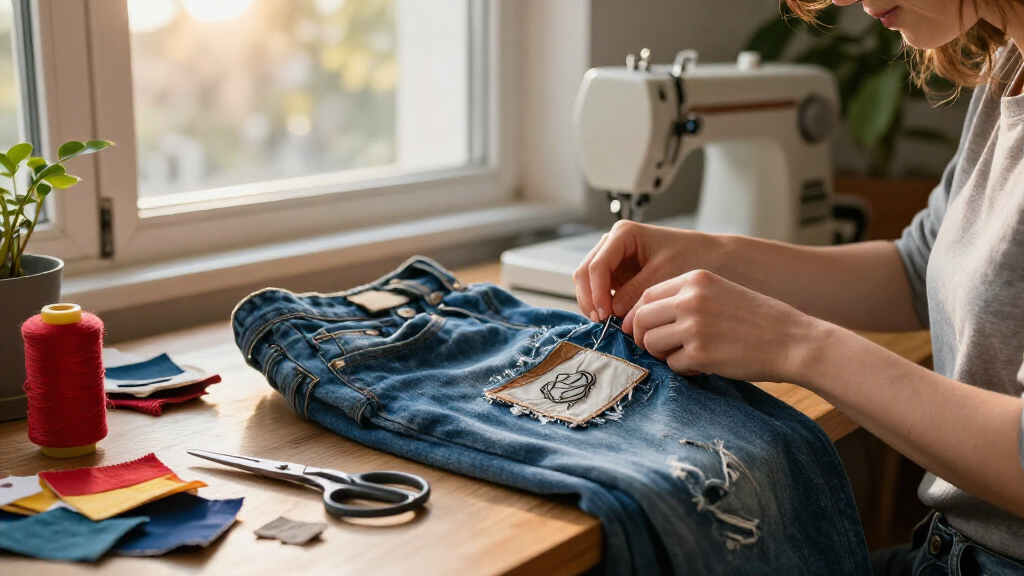
I treated DIY denim kit as a broad but practical category: a useful pick might supply fabric and embroidery materials for making something, or provide patches and tools for repairing denim garments. I did not rank these five as if they all did the same job. Instead, I looked at the work each one enables and whether the supplied contents fit that work.
For embroidery and craft kits, I weighed the range of materials, the usefulness of included patterning aids, and how readily a beginner could begin a small project. That gives CATNOINU an advantage for structured sashiko: its denim, thread, stencils, printed pattern sheets, and marking pens form a more complete path from design to stitching. The Denim Sewing and Sashiko kit earns a different place because its fabric and tools support several kinds of handwork and stuffed crafts, even though its description does not list pattern templates.
For repair products, I compared patch quantity, color choices, dimensions, and attachment method. Both patch sets offer 20 pieces in five shades at roughly the same stated size, so their instructions and reinforcement considerations help distinguish them. KING MOUNTAIN specifies an ironing temperature and duration and includes sewing kits, while YUNJSFV describes trimming and calls out a 24-hour wait before washing. Neither should be treated as a guaranteed fix for every garment or fabric condition.
I also considered portability and scope. Dritz is a compact sewing supply case that can address quick repairs, but it does not include denim pieces, sashiko thread, or patches. That makes it a useful adjacent option for someone building a small repair kit, not a substitute for a project-specific denim set. I have not assumed hands-on testing, wash durability, or performance beyond the supplied product details; my ranking reflects stated contents, intended use, and disclosed limitations.
Factors to Consider When Choosing Best DIY Denim Kits
I would start by naming the job, not by counting pieces. A kit that is excellent for decorative sashiko can be the wrong choice for a hole that needs covering before the next wash. Use these distinctions to match the contents to the work you actually plan to do.
Decide whether you want to make, mend, or keep tools handy
For a project built around stitching and design, CATNOINU is the strongest fit because it supplies denim, thread, marking tools, and several pattern methods. The Denim Sewing and Sashiko kit is less pattern-directed but more varied: it adds assorted-wash fabric, basic tools, filling, and googly eyes. That makes it attractive for small craft experiments, though those extra pieces do not help much with routine garment repair.
If the main job is covering damage, compare KING MOUNTAIN and YUNJSFV instead. Both list 20 patches in five shades at similar dimensions, but KING MOUNTAIN includes sewing kits for extra reinforcement, while YUNJSFV specifies waiting 24 hours before washing and notes that thick or high-friction areas may benefit from edge stitching. Dritz answers a different need: a compact set of tools for a small hand-sewn repair, without patches or project fabric.
Check what a starter kit actually supplies
A kit may sound complete while leaving a major step to the buyer. CATNOINU lists fabric, cotton thread, needles, tools, and pattern-transfer materials, so its contents support a more structured first embroidery project. The Denim Sewing and Sashiko kit supplies fabric and hand-sewing tools, but no patterns are listed; plan to bring your own design or work freehand. Dritz supplies many basic repair implements, but no denim pieces or patch material.
For patches, confirm whether you will need an iron, matching thread, or additional stitching supplies. Both patch sets rely on heat, and KING MOUNTAIN specifies an iron at 330°F for one minute. It also lists sewing kits, but its description says no instructions are provided. YUNJSFV gives a maximum temperature and approximate application time, yet no sewing accessories are listed. Read the package directions and garment care label rather than assuming every fabric tolerates the same heat.
Match fabric scale to the project
Small fabric pieces suit practice swatches, appliqué, patches, and compact crafts. CATNOINU’s six pieces measure 20 × 25 cm each; the Denim Sewing and Sashiko kit includes five pieces of approximately 20 × 30 cm. Neither gives you enough yardage for a large garment or a broad upholstery project. Their value is in providing project-ready scraps, not replacing fabric-by-the-yard supplies.
Patch dimensions matter in a different way. KING MOUNTAIN’s 3 × 4.25-inch patches and YUNJSFV’s roughly 3 × 4⅛-inch pieces cover modest repair areas and can be trimmed. Before applying one, check that it covers beyond the damaged section and suits the garment’s fabric and care needs. A patch that only spans the hole may leave worn edges exposed; added stitching may be useful where the garment bends or rubs.
Choose pattern help or creative freedom
Pattern aids reduce the planning work but introduce cleanup. CATNOINU gives buyers reusable plastic stencils, water-soluble printed sheets, and heat-erasable pens. Those are three different routes to marking a design, but the cleanup method depends on what you use: printed sheets need soaking, and pen marks are designed to disappear with heat. A beginner should be comfortable following the product’s handling directions before starting on a finished garment.
The Denim Sewing and Sashiko kit leaves more room to improvise, but it does not list templates or pre-printed motifs. That can suit someone who already has a design in mind and wants different denim washes for contrast. If you prefer a supplied pattern and a more guided start, CATNOINU is the clearer pick. If your project is a simple repair rather than decorative stitching, either patch set avoids the need to plan an embroidery pattern.
Think about durability and care after application
Iron-on patches are convenient, but their suitability depends on garment fabric, placement, heat tolerance, and wear. YUNJSFV specifically flags edge stitching for thick denim or high-friction locations and recommends waiting 24 hours before washing. KING MOUNTAIN lists sewing kits for reinforcement, but its product details do not provide instructions. I would treat sewing as a useful option for a hard-wearing repair, not assume that adhesive alone will suit every knee, seat, or bag strap.
Embroidery has a different tradeoff: it takes more time, but the stitching can become part of the visible design. CATNOINU supplies the most focused patterning setup; the broader Denim Sewing and Sashiko kit supplies more kinds of craft material. Neither product description establishes wash performance for a finished project, so follow the materials’ care directions and consider testing a marking method on a spare piece before working on a garment you value.
Consider storage and portability
If the kit will live in a travel bag, dorm drawer, or small repair basket, Dritz has the clearest case. Its 2.88-ounce weight and elastic organizers make it easier to carry than a collection of loose fabric and craft supplies. Its tradeoff is narrow scope: it is built around small sewing fixes, not full denim projects. It also has only eight basic thread colors, so it may not blend seamlessly with every garment.
The fabric-and-embroidery kits make more sense at a work surface, where there is room to sort thread, mark patterns, and handle scraps. Patch sets are compact to store, but their use still depends on access to an iron and a safe, suitable place to apply heat. Choose the storage format around where the work will happen, not only around the product’s piece count.
Frequently Asked Questions
Which kit is best for learning sashiko?
I would start with the CATNOINU Japanese Sashiko Embroidery Starter Kit because it includes embroidery thread, denim pieces, needles, reusable stencils, water-soluble pattern sheets, and marking pens. That mix gives a learner several ways to lay out a design. The Denim Sewing and Sashiko kit can also support sashiko, but its listed contents do not include pattern sheets or templates, so it is better for a maker comfortable planning a design independently.
Are iron-on denim patches a good choice for a hole in jeans?
They can be a practical option when the garment can tolerate the recommended heat and the patch covers the damaged area adequately. KING MOUNTAIN specifies an iron at 330°F for one minute, while YUNJSFV gives a maximum temperature of 330°F and an approximate 60-second application. For thick denim or a high-friction location, YUNJSFV says edge sewing may improve hold; KING MOUNTAIN includes sewing kits for added reinforcement. Check the garment care label and follow the patch directions before applying heat.
What is the difference between the two 20-piece patch sets?
Both KING MOUNTAIN and YUNJSFV provide 20 patches in five shades, with dimensions around three by four inches. KING MOUNTAIN lists cotton denim, a 0.2 mm hot-melt adhesive layer, and sewing kits for reinforcement, but its product description says instructions are not provided. YUNJSFV says patches can be trimmed, gives heat guidance, and recommends waiting 24 hours before washing; it also notes that edge stitching may help on high-friction areas. I would pick between them based on whether included sewing supplies or explicit aftercare guidance matters more.
Can I use the embroidery kits to repair jeans?
Yes, both embroidery kits can support hand stitching or decorative mending, but their supplied denim pieces are project material rather than patches sized to cover a garment hole. CATNOINU is more pattern-oriented, while the Denim Sewing and Sashiko kit has assorted denim washes and general craft tools. For a repair on an actual pair of jeans, consider the size and placement of the damage, whether you want visible stitching, and whether you have suitable fabric to place behind or over the worn area.
Which option makes the most sense for a beginner who only wants basic repairs?
For small repairs such as a loose button or a minor seam issue, I would choose Dritz if portability and a basic tool assortment are the priority. It includes needles, pins, scissors, a seam ripper, tape measure, thimble, and assorted thread in a compact case. If the repair is a hole or worn patch of denim, a patch set is more directly suited to covering it. Dritz does not include denim fabric or iron-on patches, so it is not a one-box solution for every kind of garment damage.
Conclusion
My picks depend on the work ahead. For pattern-led sashiko and visible mending, choose CATNOINU; for assorted denim scraps and playful, mixed craft projects, choose the Denim Sewing and Sashiko kit. If you need to cover worn clothing, KING MOUNTAIN is my pick for its listed sewing kits, while YUNJSFV suits buyers who value trimming flexibility and its stated wait-before-washing guidance. For small repairs on the go, Dritz is the compact tool case, not a full denim kit. Match the kit to your project, check heat and care requirements before using an iron-on patch, and remember that small supplied fabric pieces are not a substitute for larger denim stock.