
TL;DR
Building your own AI workstation used to be cheaper, but in 2026, prebuilt systems often cost the same or less due to component shortages and bulk buying. Your choice depends on your need for speed, support, and custom tuning, not just dollars. Both options have pros and cons worth weighing carefully.
Imagine this: you’re ready to jump into serious AI work. You could spend weeks sourcing parts, tuning your machine, and troubleshooting. Or, you could buy a prebuilt that’s ready to go out of the box. The question isn’t just about price anymore — it’s about speed, support, and control.
In 2026, the old rule that building your own system is always cheaper no longer holds. Supply chain issues and bulk buying have reshaped the landscape. Now, your decision hinges on what you value more: the thrill of customization or the ease of immediate productivity. Let’s break down what each route offers and see which one really makes sense for your AI ambitions.
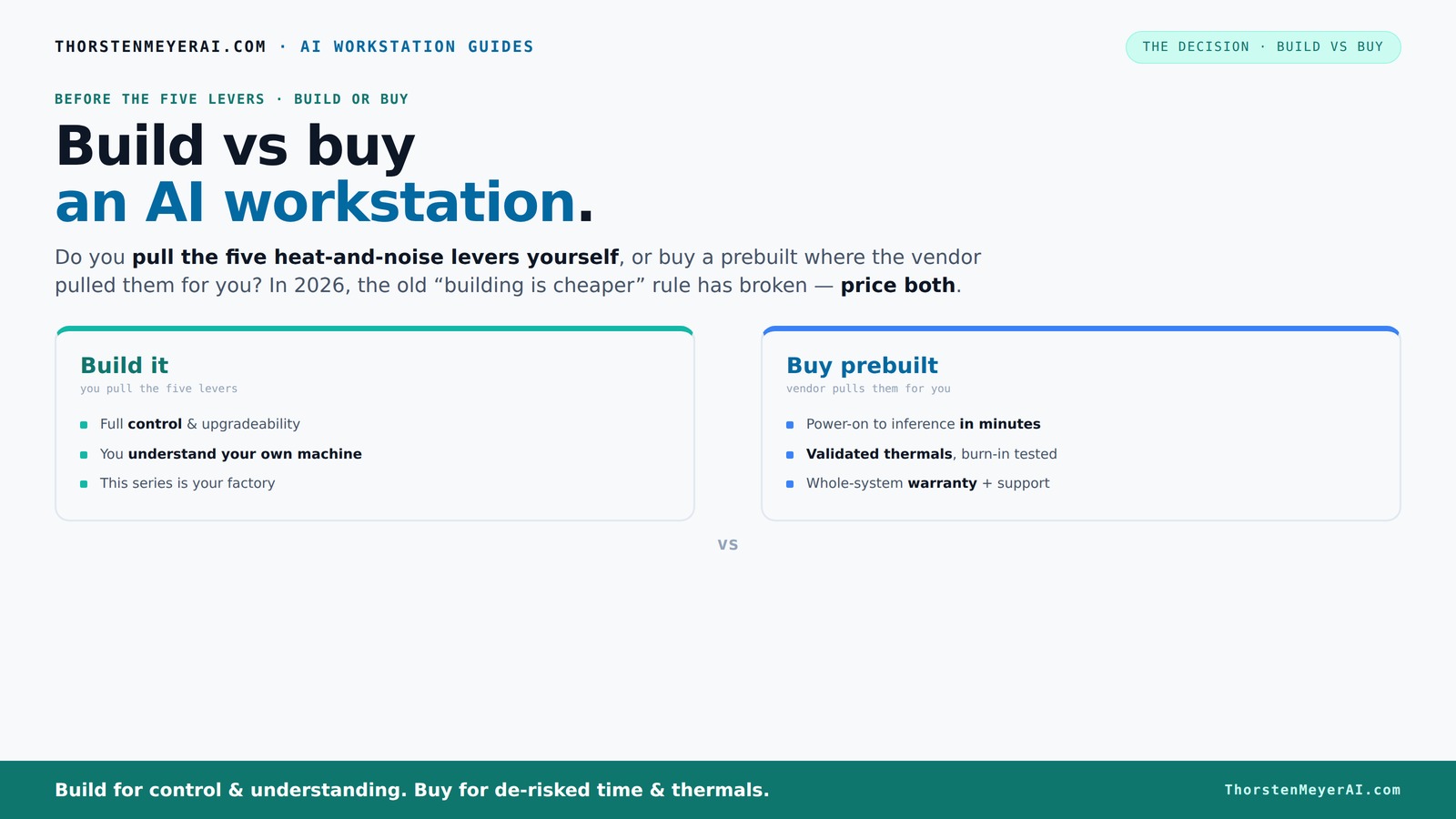
Build vs buy
an AI workstation.
The real question behind this whole series: do you pull the five heat-and-noise levers yourself, or buy a prebuilt where the vendor pulled them for you? And in 2026, the old “building is cheaper” rule has broken. Match your situation in Part 3.
Key Takeaways
- Component shortages and bulk buying have made prebuilt systems often as affordable as DIY builds in 2026.
- Prebuilts handle thermal validation and noise tuning, saving time and reducing risk for demanding AI workloads.
- Building gives you control over every part and upgrade path, but requires expertise and time investment.
- Prioritize GPU, RAM, cooling, and support when selecting components for AI workstations.
- Always compare total ownership costs, including troubleshooting and support, before deciding.

WIWB Gaming PC Desktop Core I9-14900HX, GeForce RTX 5060 Ti 8G, 16G DDR5 RAM, 1TB NVME SSD, WiFi 6, 4K 8K High-End Prebuilt PC Computer Tower for Streaming, Video Editing & Workstation Use (Black)
- Powerful Processor: Intel Core i9-14900HX with 24 Cores
- High-Performance Graphics: GeForce RTX 5060 Ti 8GB GDDR7
- Fast Memory & Storage: 16GB DDR5 RAM and 1TB NVMe SSD
As an affiliate, we earn on qualifying purchases.
As an affiliate, we earn on qualifying purchases.
Why the cost game has flipped in 2026 — building isn’t always cheaper anymore
Once upon a time, building your own AI workstation was the budget-friendly choice. You picked parts, assembled, and saved big. But today, the story has changed.
Component shortages and price hikes have pushed up DIY costs. DDR5 RAM, high-end GPUs, and fast SSDs now cost 30-50% more than just a year ago. Meanwhile, big vendors like Dell and Lambda bought parts in bulk before prices surged, and they’re passing those savings onto you.
So, a build that used to cost around $1,000 now often hits $1,250+ for the same specs. Some prebuilt systems are now priced the same or even lower, because they leverage their buying power and validation processes.
In practical terms, this means you should always price both options today, before deciding. The old rule that DIY is always cheaper no longer applies. This shift makes the decision more about time, support, and control than just sticker price.
Who pulls the levers? The real difference between build and buy
High-power AI workstations are heat and noise monsters. Making them run smoothly involves five key levers: undervolting the GPU, matching the cooling system, optimizing airflow, tuning fan curves, and choosing the right placement. If you want to learn more about optimizing hardware, check out Build vs Buy a Prebuilt AI Workstation.
When you buy a prebuilt, the vendor handles these levers. They validate thermals, run burn-in tests, and tune everything for you. Systems from Lambda or BIZON come with factory-validated cooling and noise levels, often with water-cooling options that keep temps and sound in check. For more insights, see Build vs Buy a Prebuilt AI Workstation.
If you build it yourself, you pull these levers. You choose a quiet GPU, like the quiet GPU, and undervolt it using guides like this one. You pick a case with good airflow, set up fans properly, and tune everything to your liking. If you're interested in customizing your setup, consider reading about building your own AI workstation.
This means more control but also more work. Your choice boils down to: do you want a machine optimized by someone else, or do you want to become the thermal engineer yourself?
When a prebuilt makes sense — quick, supported, and ready to run
If your priority is getting up and running fast with minimal fuss, a prebuilt is the way to go. They arrive with the OS, drivers, and AI frameworks like CUDA and TensorFlow preinstalled. Plug in, and you're ready for inference — no sourcing parts, no BIOS tweaks.
Support and warranty are also key. Reputable vendors like Puget or Lambda run extensive burn-in testing, ensuring your system won’t throttle under load. If something breaks, they fix it — often with support contracts that cover years.
Multi-GPU setups, which are notoriously tricky to tune, become much easier. Vendors validate these configurations under sustained loads, reducing your risk of thermal throttling or hardware failure.
Finally, if your time is worth money, a prebuilt saves a lot of hassle and can be cheaper overall when you factor in troubleshooting and setup time.
Building your own — control, customization, and long-term ownership
If you enjoy tinkering or need a highly customized setup, building your own AI workstation still makes sense. You get to pick every part: the CPU, GPU, cooler, case, and power supply — tailoring the machine to your workload.
For example, you might choose a quiet cooler and undervolt your GPU, optimizing for low noise during long training runs. This control can lead to better thermal performance and quieter operation — but only if you know what you’re doing.
Plus, DIY allows future upgrades. Want to add more RAM, swap in a new GPU, or upgrade the SSD? You’re in charge. For guidance on building and upgrading, visit Build vs Buy a Prebuilt AI Workstation.
However, building means investing time, energy, and some risk. Compatibility issues, BIOS tweaks, and troubleshooting are part of the process. But if you like mastery over your machine, this route offers unmatched flexibility.
Which components matter most for AI workloads?
When it comes to AI, not all parts are created equal. The GPU is king — a high-end graphics card like an NVIDIA RTX 4090 or A100 is often the backbone of any serious AI setup. Its CUDA cores and VRAM determine how fast your models train or infer.
RAM matters too — at least 64GB for large datasets or multi-tasking. Storage? Fast NVMe SSDs reduce data bottlenecks. CPU? While less critical, a strong multi-core processor keeps your system responsive.
Cooling and power supply are often overlooked but crucial. An overheated GPU throttles, and an unstable power supply causes crashes. To understand more about component choices, see minusred.com.
In short: prioritize GPU and RAM, then ensure cooling and power are solid. For example, a quiet GPU with proper undervolting can reduce noise and power draw, boosting reliability during long runs.
Cost breakdown: what do you really pay for?
Upfront, a prebuilt may seem more expensive, but it includes support, setup, and validation — saving you hours of troubleshooting. Building your own might be cheaper in parts, but add in the cost of your time, potential errors, and future upgrades.
For example, sourcing a GPU, CPU, and cooling from different vendors often involves shipping fees and compatibility checks. Plus, if you run into BIOS or driver issues, solving them can take days.
Support contracts from prebuilts cover hardware failures quickly, while DIY owners often face split warranties and support channels. Over a year, those support savings can outweigh the initial price difference.
So, think of the total cost of ownership: hardware price + labor + troubleshooting + support. Sometimes, paying a premium upfront for a validated system is cheaper overall.
Upgradeability and future-proofing — what really matters?
Many buyers want a machine they can grow with. Prebuilt systems often come with proprietary parts that limit future upgrades — especially in cooling or power modules. This can lock you in for years.
DIY builds excel here. You choose standard components, so adding RAM, swapping GPUs, or upgrading storage is straightforward. For example, upgrading to a newer GPU in your DIY rig might just mean a new PCIe card and a driver update.
However, some high-end prebuilts now include modular designs that simplify upgrades. Always check the upgrade path before buying.
In essence: if future expansion is key, DIY offers more control. But if you prefer a ready-to-run system with some upgrade options, a carefully chosen prebuilt can also work.
Support, warranty, and risk management: what’s your safety net?
Support and warranties matter more in AI work than you might think. Prebuilt vendors often bundle multi-year support, on-site repairs, and quick replacements. Lambda, for example, offers up to 5 years of support with on-site service.
DIY builds split warranties: CPU, GPU, RAM all come with their own support channels. Troubleshooting can become a game of ping-pong between vendors.
For mission-critical AI applications, support isn’t optional. It can save days or weeks if hardware fails during a training run.
So, consider your risk appetite. If downtime costs you heavily, a prebuilt with a strong warranty makes sense. Otherwise, DIY offers control, but with more support hassle.
Final thoughts: which should you choose?
Choosing between build and buy isn’t just about dollars. It’s about your goals, skills, and how much time you want to spend tuning. If speed and support top your list, a prebuilt offers a safe, validated path. If control and customization matter more, building your own can be a rewarding challenge.
Remember, in 2026, component costs and market dynamics have shifted. Always price both options today, factoring in your time, support needs, and future plans.
Ultimately, your ideal workstation aligns with your workflow and comfort level. Whether you assemble or buy, your AI journey begins with the right choice.
Frequently Asked Questions
Is a prebuilt AI workstation good enough for serious AI work, or should I build my own?
Prebuilts from reputable vendors like Lambda or BIZON are often more than capable for serious AI tasks. They come with validated thermals, optimized hardware, and support, making them a reliable choice for demanding workloads.Which option is cheaper once I include software, labor, and support?
In 2026, component prices have risen, making prebuilt systems often as cost-effective as DIY. When you factor in your time, troubleshooting, and support costs, prebuilts can actually be cheaper overall, especially for complex multi-GPU setups.Do prebuilts use better or worse components than custom builds?
Prebuilts typically include validated, high-quality parts, but sometimes proprietary or custom cooling solutions. Custom builds can source specific parts, but require more expertise to ensure compatibility and quality.How important is an NPU or AI-specific hardware for workstation tasks?
AI-specific hardware like NPUs or accelerators can significantly boost performance and efficiency for certain workloads. Many prebuilt systems now include these features, making them attractive for heavy AI training and inference.Can I upgrade a prebuilt later, or will it lock me in?
Upgrade paths vary. Some prebuilts use standard components, allowing upgrades, but others have proprietary parts that limit expansion. Always check the upgradeability before purchasing if future growth matters.Conclusion
In the end, your choice between build and buy hinges on what you value most: immediate performance and support or control and customization. The market has shifted, so don’t assume DIY is always cheaper. Instead, weigh your needs, skills, and how quickly you want to deploy.
Whatever you decide, remember that your AI workstation is a tool — the better it fits your workflow, the faster your ideas become reality. Now, go choose the machine that makes you eager to start building.